Project Overview
A national innovation project that connects preclinical and clinical research through data and AI to increase the probability of success in drug development.
Project introduction
The K-AIPA project is a national R&D initiative designed to build an AI-based clinical trial design and support platform by integrating non-clinical and clinical data. It aims to dramatically improve the efficiency and success rate of the entire drug development lifecycle. More than 30 industry, academia, research, and hospital organizations participate in this large-scale collaborative program, combining data, AI, and clinical capabilities to present a new paradigm for drug development.
Background and need
From preclinical studies to final commercialization Average success rate
only 9.6%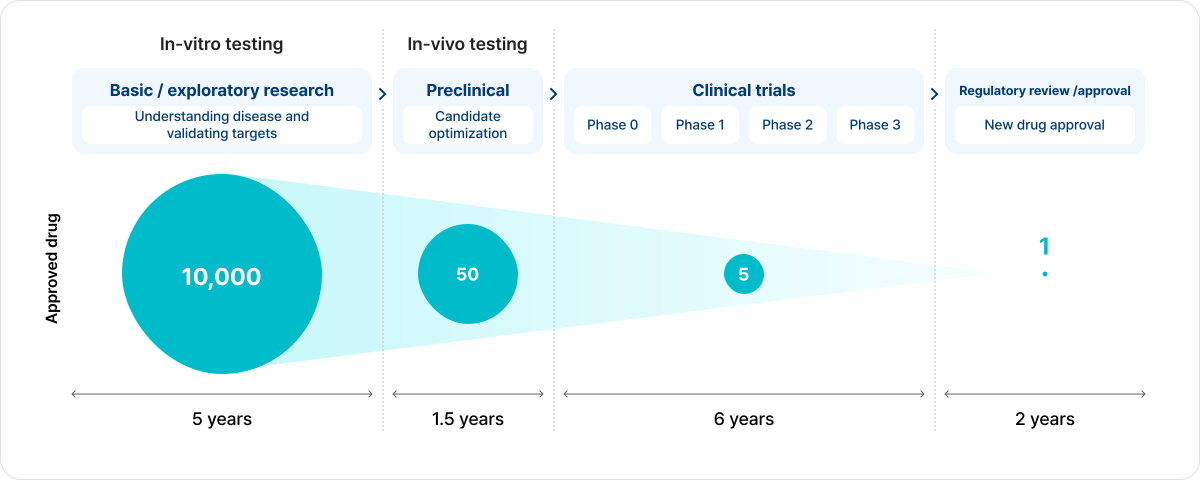
Number of successful candidate compounds by stage of new drug development
Source: Biotechnology Innovation Organization, BIO
Key issues
Lack of training data for drug development because institutions cannot easily share data
Limits on data sharing and use due to privacy and business confidentiality
Need to overcome the performance limits of predictive models in healthcare and pharmaceuticals through federated learning.
: Traditional drug development faces structural limitations, including disconnection between preclinical and clinical research, restrictions on data use, and high failure rates. Key barriers include the difficulty of translating preclinical findings into clinical outcomes, limited data sharing between institutions, inefficient clinical trial design, and high development costs. This project strengthens the preclinical-clinical link through AI and data integration, building a more precise and efficient drug development system.
Project goal
Establishment of an AI-based clinical trial design and support platform for drug development, and improvement of clinical trial efficiency and success rates through the development of AI technologies linking preclinical and clinical stages.

Build an AI-based clinical trial design and support platform using non-clinical and clinical data.

Secure technologies that connect non-clinical and clinical drug development.

Build an AI drug development system based on multimodal data and foundation models.

Ensure industrial usability through validation and commercialization.
Major activities

- Integrate non-clinical data (cell-based, animal, ADMET, etc.), clinical data, and omics data into a unified data platform.
- Establish data standardization and quality validation frameworks.
- Build scalable datasets that include both successful and failed experimental outcomes.

- Develop AI models for predicting drug response, toxicity, and optimal dosage.
- Enable precision medicine through biomarker discovery and patient stratification analysis.
- Develop multimodal foundation models and agent-based AI orchestration capabilities.

- Build a federated learning platform that enables inter-institutional collaboration without data transfer.
- Implement secure and privacy-preserving AI training environments.
- Establish AI collaboration and operational frameworks (MLOps/AIOps).

- Support clinical trial design through patient cohort selection, dose optimization, and simulation studies.
- Apply quantitative pharmacology models, including PBPK (Physiologically Based Pharmacokinetic) and QSP (Quantitative Systems Pharmacology) models.
- Develop support systems for IND approval processes and clinical trial operations.

- Validate real-world clinical applicability through collaboration among pharmaceutical companies, hospitals, and CROs.
- Improve efficiency through automation of clinical trial design and operations.
- Facilitate technology dissemination and commercialization across the pharmaceutical industry.
Expected impact
- Clinical development accounts for more than 60% of total development costs and over 30% of the overall development timeline.
- Even if a drug candidate succeeds in the non-clinical stage, more than 90% fail during clinical trials.
- Mismatch between non-clinical and clinical outcomes (species gap, patient heterogeneity).
- Translational research is primarily forward-directed, with limited reverse feedback from clinical results, leading to repeated failures.
- • Since 2022, the FDA has allowed IND submissions based on in silico and organoid-based evidence without animal testing. However, in Korea, regulatory frameworks remain largely dependent on animal-testing-centered systems.
- Clinical data sharing and AI model training are restricted due to privacy regulations and IRB requirements.
- Lack of a federated learning platform specialized for drug development in Korea.
A Next-Generation Platform Connecting Disconnected Non-Clinical and Clinical Processes with AI to Improve Drug Development Success Rates
- Agentic AI orchestration that automatically links QSP modeling, dose prediction, and patient selection to optimize clinical trial design.
- Federated learning–based framework to ensure trustworthiness, privacy protection, and industrial usability.
- Development of an AI-driven clinical trial design and support platform.
- Development of a multimodal foundation model integrating EHR, medical imaging, omics, and molecular data.
- Integration of translational research, reverse translation, and animal-replacement AI software.
- Establishment of predictive AI technologies that improve the probability of successful translation from non-clinical to clinical stages.
- Collaborate with regulatory authorities to validate AI- and in silico-based testing methodologies and contribute to guideline development.
- Ensure global regulatory compliance by aligning with FDA and EMA regulatory trends.
- Leverage domestic research outcomes to achieve global regulatory acceptance and support international clinical trials.